From blind spot to system change: The Netherlands Women’s Health Research & Innovation Center
What started, as the co-founders describe it, “with a box of T-shirts and a shared ambition,” has quickly grown into one of the Netherlands’ most visible initiatives in women’s health innovation. Founded just over a year ago at Erasmus MC, the Netherlands Women’s Health Research & Innovation Center was created to confront a long-overlooked reality in healthcare: the women’s health gap.
For co-founders Hanneke Takkenberg and Jeanine Roeters van Lennep, building on an initiative originally co-founded with Greet Vink, the center reflects the culmination of years of work across medicine, research, and advocacy. Takkenberg is a professor of cardiothoracic surgery at Erasmus MC and a clinical epidemiologist working on complex clinical decision-making. Shared decision-making, she explains, has always been central to her work. Over time, her focus widened toward gender differences across multiple areas of medicine.
“That fascination with sex differences in medicine, combined with my work on inclusion and equitable representation in academia, all came together in this center,” she says. She served as chief diversity officer at Erasmus University and leads the Erasmus Center for Women and Organisations at the Rotterdam School of Management, where healthcare, leadership, and inclusion increasingly overlap.
Roeters van Lennep is an internist and professor in cardiovascular prevention, with a focus on sex-specific factors. Her interest in gender differences began during medical school and gradually expanded from cardiology into broader questions in women’s health. “I was already interested in sex differences in cardiovascular disease,” she explains.
“Later, I realised how many fields see the same patterns, but we were not talking across disciplines.” Together with a colleague, she helped establish a women’s health course that brought together perspectives from across medical specialities. It quickly became clear how widespread the issue was. “People from completely different fields approached us saying: ‘We see these differences too. Why are we not talking about this more?’”
Breaking the silos
According to Roeters van Lennep, women’s health has long been defined too narrowly for too long, often limited to reproductive health and gynaecology.
“Everything considered ‘women-specific’ automatically became the domain of the gynaecologist,” she says. “But healthcare becomes much better when you work across disciplines, and we need to make that the new standard.”
The co-founders deliberately moved away from a traditional institutional structure. “What surprised me most,” Takkenberg says, “is that building this ecosystem, approach works. Instead of a traditional structure with silos, we are building something much more inclusive and collaborative.”
“It’s a rather feminine way of organising, which fits perfectly with the theme,” she adds.
From awareness to action
Within months of launch, the center was already part of conversations far beyond academia. Attention quickly grew, first in the media and soon among policymakers, healthcare institutions, and international organisations.
“We suddenly found ourselves speaking with national stakeholders such as the Municipality of Rotterdam and the Ministry of Health, but also health insurers, universities, and companies, with strong engagement within Erasmus MC as well,” Takkenberg explains. “There is a growing recognition of how urgent the women’s health gap really is, and many parties are interested in supporting the center. “
Roeters van Lennep adds that the reach quickly extended beyond the Netherlands. “We were called to Brussels for consultations in the European Parliament on women’s health.”
One of the center’s first major milestones came with Menopause Matters, a €5 million Health~Holland PPP programme focused on turning women’s health innovation into practical solutions. The consortium connects Erasmus MC, Amsterdam UMC, the University of Twente, the Borski Fund, Vuurvrouw, and other partners around cardiovascular, mental and brain, and musculoskeletal health. “In the Rotterdam way of thinking, you don’t just talk about innovation,” Takkenberg says. “You make it happen.”
Unlike more traditional academic funding models, projects are also assessed on societal and economic value, with industry partners expected to co-invest throughout the process. “That combination makes it challenging,” Roeters van Lennep says, “but it creates a much stronger bridge between science, healthcare, and implementation.”
A broader vision for women’s health
Beyond specific projects, the center advocates for a holistic life-course approach to women’s health. “Women’s health has traditionally been reduced to pregnancy or reproductive organs,” Roeters van Lennep explains. “But every healthcare professional treating women is dealing with women’s health.”
The approach looks not only at biological differences, but also at how health interacts with careers, financial security, and social participation over time.
“By holistic care, I also mean its impact on careers, social roles, and economic position,” Takkenberg says. “Women contribute enormously to society, yet they are also more likely to end up in poverty or build less financial security over time. Better health has a major impact on improving those outcomes.”
She believes the conversation needs to shift fundamentally. “We should stop framing this only as a women’s health problem,” she says. “It is also a women’s health opportunity.”
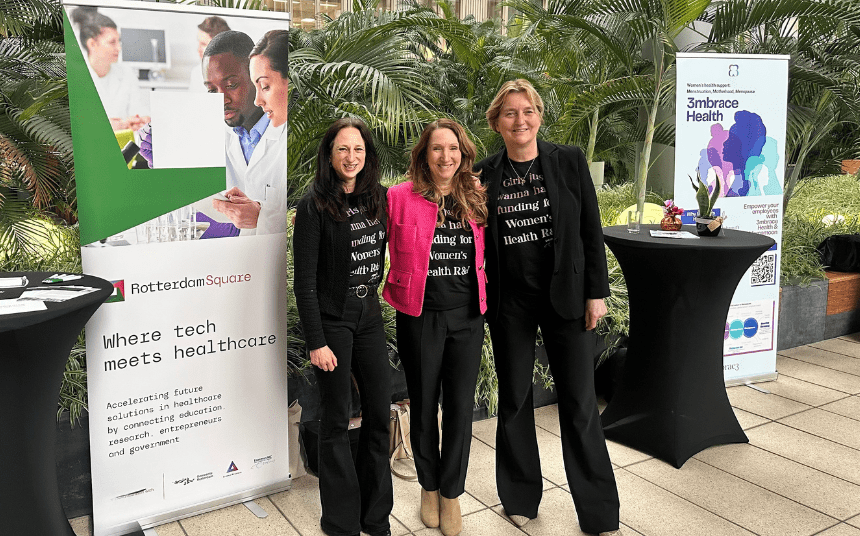
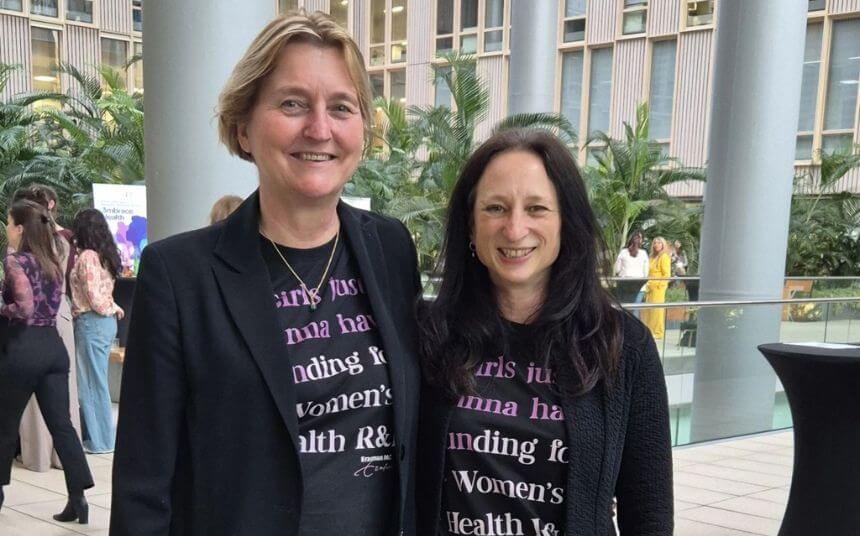
Left to right: Jeanine Roeters van Lennep, Sharon Mullen, and Hanneke Takkenberg celebrating the 1-year anniversary of the Netherlands Women’s Health Research & Innovation Center.
Rethinking health data
One of the center’s concrete ambitions for the coming year is improving how female-specific data is captured within healthcare systems. “There is a lot of information relevant to women’s health that we simply do not register today,” Takkenberg explains.
The team is exploring how factors such as menstrual cycle data and other female-specific variables could be integrated into electronic patient records at Erasmus MC. “Europe is currently building a shared health data space. If this data is not included now, it will not be analysed later.”
The initiative reflects a broader concern: current healthcare datasets and AI systems often underrepresent women. “We need diverse expertise to solve these challenges,” Takkenberg says. “Clinicians, data scientists, ethicists, innovators and policymakers all need to work together.”
Building the Rotterdam ecosystem
Rotterdam plays a central role in that vision. As the Netherlands’ most culturally diverse city, it offers a unique setting to explore how women’s health connects to wider social challenges.
“In Rotterdam, there is a real willingness to create initiatives that go beyond the walls of hospitals and universities.” Takkenberg says. The network already stretches across healthcare, government, academia, and the social sector, including projects in Rotterdam Zuid that address unemployment and inequality.
The ambition is a truly transdisciplinary ecosystem: one that connects hospitals, GPs, researchers, social organisations, industry partners, and citizens. Organisations such as Rotterdam Square have also helped connect the center to companies and innovation partners.
“The events organised together with Rotterdam Square are extremely valuable,” Takkenberg says. “Our researchers could directly meet companies and ecosystem partners working in relevant fields.”
At the same time, the co-founders emphasise that long-term growth will depend on structural funding and sustained partnerships.
“Our name now helps attract project funding,” Takkenberg explains. “But to truly build this ecosystem for the future, we also need long-term support and strategic collaborations.”
That ambition extends beyond Rotterdam. The center hopes its model can inspire similar hubs across the Netherlands. “There is enthusiasm at other universities and hospitals,” Roeters van Lennep says. “We are happy to share our lessons learned and expertise.”
Investing in society
Although the center is still shaping its long-term direction, one message already stands at its core. “Investing in women’s health is not a cost,” Roeters van Lennep says. “It is an investment.”
An investment, the co-founders argue, not only in healthcare outcomes, but also in economic resilience, social participation, and the sustainability of society. “Improving women’s health benefits everyone,” Takkenberg concludes. “Not only women, but society as a whole.”
The impact, she says, extends far beyond women alone. “My hypothesis is that men will ultimately live longer and healthier once we start taking women’s health seriously.”
Interested in collaborating with the Netherlands Women’s Health Research & Innovation Center? Visit the website to learn more.
For research collaborations, industry partnerships, or opportunities to engage with the Rotterdam ecosystem, please contact our Senior Account Manager Sharon Mullen.
Date: May 20, 2026